%20(1).svg)
Jira Service Management Virtual Agent: Overview & Limitation
Get a clear overview of Jira’s Virtual Service Agent, including what it is, how it works, and how to set it up. We also cover limitations and how Risotto compares.


Jira Service Management’s Virtual Service Agent is an AI-powered feature designed to automate support interactions directly in Slack and the JSM customer portal. It’s available on Atlassian Cloud Premium and Enterprise plans, and it’s powered by Atlassian Intelligence.
In this article, we’ll cover:
- An overview of JSM’s Virtual Service Agent: What it is, the two primary ways to configure it (intent flows and AI answers), and how it works in practice. We link to Atlassian’s official Virtual Service Agent guide for the full setup walkthrough.
- Where Virtual Service Agent hits a ceiling: The limitations IT teams run into when relying on Virtual Service Agent for automated ticket resolution, and how Risotto addresses them. Risotto is our AI-native ITSM that augments Jira Service Management and automates 20–60%+ of internal support issues. It was co-founded by Alex Confer, who previously led IT engineering at Dropbox and Gusto. Explore our origin story.
- Case studies & results from IT teams using Jira Service Management who added Risotto to close the gap between JSM’s native AI capabilities and the ticket auto-resolution rates they were looking for:
- Hazel Health switched from Jira Assist & Virtual Service Agent to Risotto and improved automation rates from 3–5% to 20%+. (Read full case study.)
- Trust & Will used Risotto as the AI ticket-resolution layer on top of JSM and automated 35% of IT tickets. (Read full case study.)
- ThoughtSpot integrated Risotto with Jira, Slack, and Okta in less than a week, automating 48% of IT tickets and reducing resolution time from 31 to 6.5 hours. (Read full case study.)
- Gusto integrated Risotto with Jira, Slack, Confluence, and Okta in 2 weeks, auto-solved 53% of IT tickets on day one, and saved 114,000 hours of support wait time. (Read full case study.)
- Jobber integrated Risotto with Slack, Jira Service Management, AWS, Jamf, and Confluence in 2 days, achieving 38% IT ticket automation and saving 2,747 hours of support wait time. (Read full case study.)
- Hazel Health switched from Jira Assist & Virtual Service Agent to Risotto and improved automation rates from 3–5% to 20%+. (Read full case study.)
What Is Jira Service Management’s Virtual Service Agent?
The Virtual Service Agent is JSM’s AI-powered bot that attempts to resolve support requests automatically — before they reach a human agent. It sits on top of Atlassian Assist (JSM’s conversational ticketing extension for Slack and Teams).
For the full setup walkthrough and configuration details, Atlassian’s official guide is the best resource. Below, we’ve summarized the key points.
Virtual Service Agent in a Nutshell
The Virtual Service Agent is powered by Atlassian Intelligence and is available on JSM Cloud Premium and Enterprise plans. Project admins can manage it from Project settings > Virtual service agent — no coding or data science background required.
At a high level, it works like this: when an employee sends a message in a connected Slack request channel (or the JSM customer portal), the Virtual Service Agent tries to match the request to a pre-configured response. If it can resolve the request, it does so without involving a human agent. If it can’t, it creates a JSM issue and escalates to your team.
There are a few things to set up before it’s useful. You’ll need to select a default request type (used when the bot can’t resolve something and needs to create an issue), and then configure one or both of the two primary resolution methods described below.
Two Ways to Configure It: Intent Flows & AI Answers
There are two primary ways to configure how the Virtual Service Agent responds to requests. You can use one or both.
1. Intent Flows
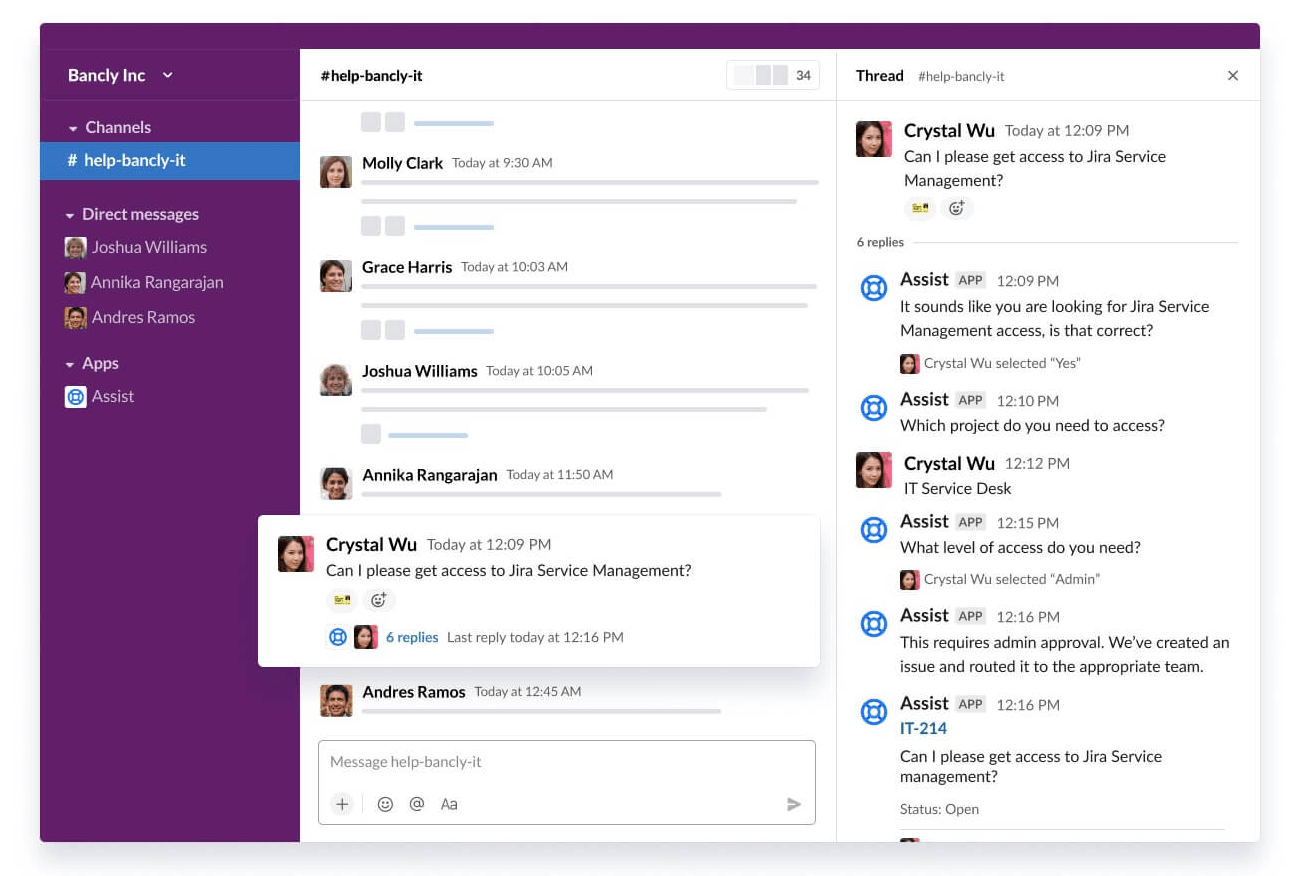
Intent flows are pre-defined conversation trees that guide employees through a structured interaction. You create an “intent” (like “Password Reset” or “Software Access Request”), train it with example phrases your employees might use, and then build a step-by-step conversation flow the bot follows when it detects that intent.
These flows can include branching options, information collection, and even web requests to trigger automated actions (like granting software access via an API call). Atlassian provides both data-driven templates (generated from your recent ticket history) and out-of-the-box templates for common IT and HR scenarios.
Intent flows are best for requests that:
- Require guided troubleshooting or a specific sequence of steps
- Need information collected from the employee (like which tool they need access to)
- Can trigger an automated action via a web request
The catch: each intent needs to be created, trained with phrases, and have its conversation flow built manually. Atlassian recommends around 20 training phrases per intent for best results, and the flows need ongoing tuning as you monitor performance.
2. AI Answers (Atlassian Intelligence)
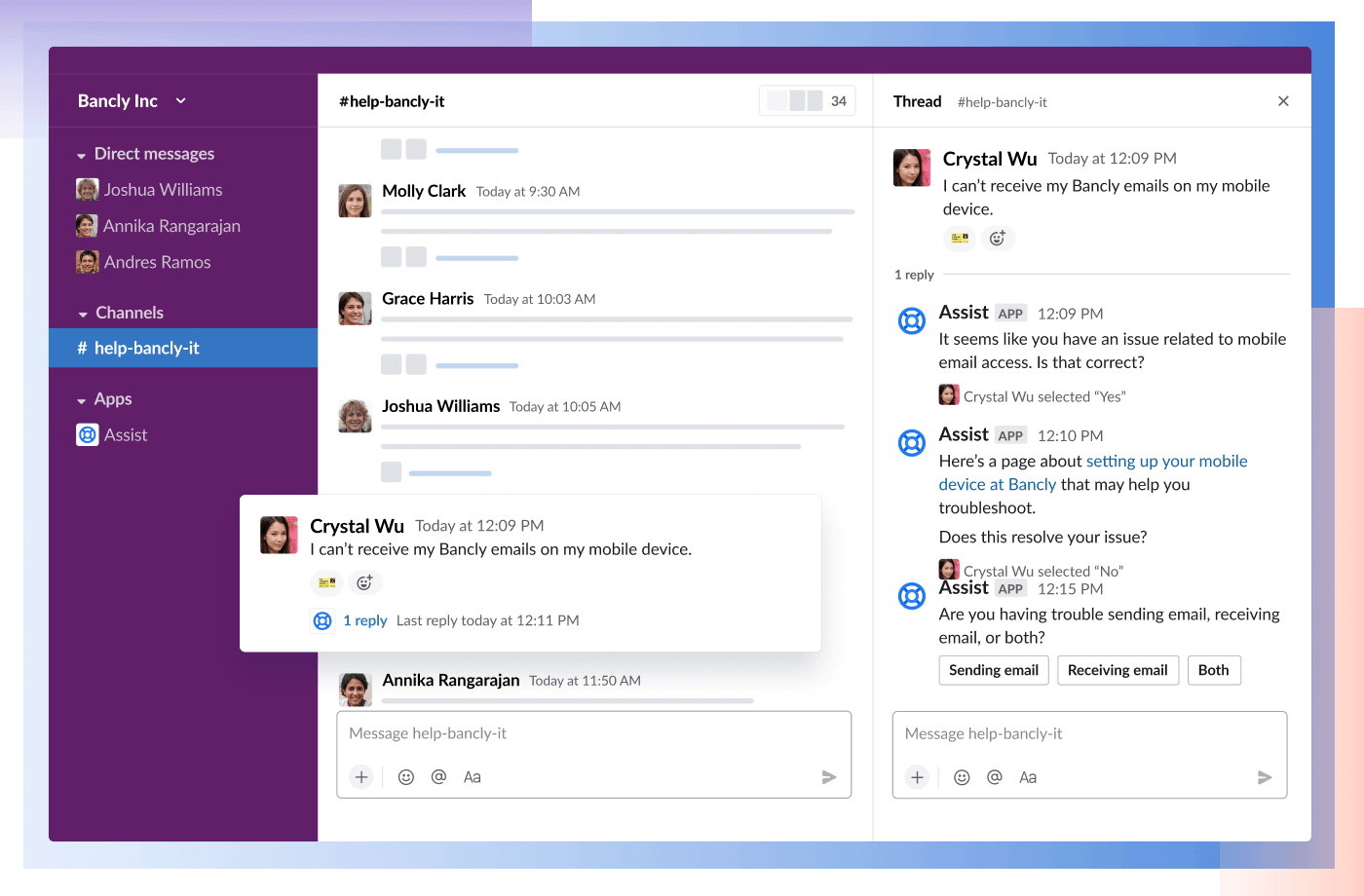
AI Answers uses generative AI to search your linked knowledge base articles (e.g., Confluence or JSM’s native KB) and generate conversational responses to employee questions. Unlike intent flows, there’s no manual conversation building — you connect your knowledge base, activate AI Answers, and the AI agent tries to triage or answer questions based on what’s in your articles.
AI Answers work best for customer questions that:
- Can be resolved by providing information or instructions
- Are already covered in your existing knowledge base
- Don’t typically need to be escalated to a human agent
The quality of AI Answers depends directly on the quality of your knowledge base. Atlassian’s guide emphasizes keeping articles up to date, avoiding duplication, and using the same language your employees use when searching.
The Ceiling
These are solid building blocks for automating basic support interactions. But in practice, many IT teams find that the Virtual Service Agent’s results are inconsistent.
Intent flows require significant manual configuration and ongoing maintenance, AI Answers can be hit-or-miss depending on your KB quality, and the AI doesn't automatically learn from how your agents resolve tickets in Slack. You're stuck on a KB treadmill where the only way to improve the bot is to manually write and update articles.
The result: teams often invest weeks or months into configuration and still end up with lower auto-resolution rates than expected.
That’s the gap Risotto was designed to fill. Risotto is our Slack-native AI IT agent that augments your existing Jira Service Management setup, can be set up in hours (not weeks or months), and delivers higher ticket automation rates. The rest of this article covers where Virtual Service Agent falls short and how Risotto addresses each limitation.
Where Virtual Service Agent Falls Short — and How Risotto Fills the Gap
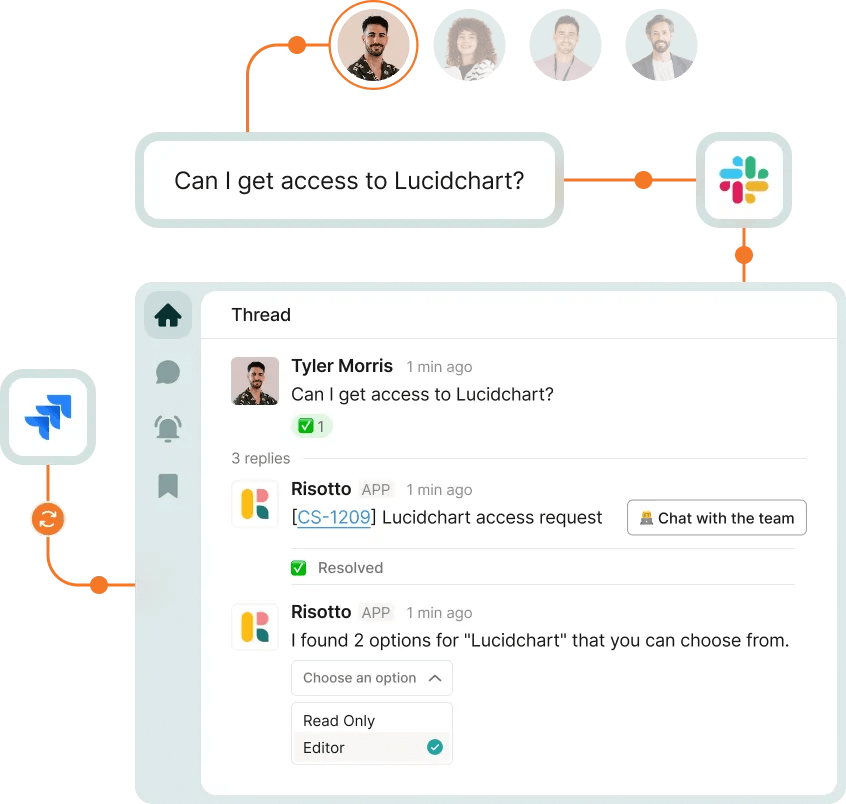
Before diving into the specifics, here’s what Risotto is and how it works alongside Jira.
Risotto is our AI IT agent built specifically to work alongside Jira Service Management. It operates natively in Slack with a seamless bi-directional sync to JSM — every conversation, ticket, and resolution flows between both systems automatically.
Risotto focuses on auto-resolving the tier-1 ticket categories that make up the bulk of IT volume:
- Knowledge questions: “How do I reset my password?”, “Where’s the expense policy?”
- Access requests: “I need Figma access”, “Can you provision me for Salesforce?”
- MDM actions: Integrations with Jamf and Kandji
- HRIS connect flows: Onboarding, offboarding, HR policy questions, etc.
Here’s what that looks like across our customer base:
- Fundrise: Automated nearly 60% of IT support tickets
- ThoughtSpot: Automated nearly 48% of IT support tickets
- Superhuman: Automated nearly 20% of IT support tickets
- Ironclad: Automated nearly 90% of access-related IT requests
- Trust & Will: Automated nearly 35% of IT support tickets
- Gusto: Automated nearly 55% of IT support tickets
- Thinkific: Automated nearly 46% of total support tickets
- Jobber: Automated nearly 38% of IT support tickets
- Hazel Health: Improved deflection rates from 3–5% to over 20%
- Shakepay: Automated nearly 40% of IT support tickets
- Retool: Reduced SLA resolution time from an average of 2 days to under 1 day
- Vidyard: Automated nearly 56% of IT support tickets
Risotto was co-founded by Alex Confer, who previously led IT engineering at Dropbox and Gusto. At Gusto, managing nearly one SaaS application per two employees across a 1,000+ person org meant the IT team was buried in tier-1 tickets instead of doing strategic work. And the automation tools they invested in fell short, with KB-powered bots serving unhelpful responses and IGA tools that operated through separate portals employees ignored.
Risotto was built to solve both problems in the place employees already work: Slack. Explore our origin story.
Here are 5 areas where the Virtual Service Agent falls short and how Risotto addresses each:
1. Why Most Teams Plateau at Low Auto-Solve Rates
One of the patterns we see constantly during customer pilots: an IT leader gets excited about automating some complex, niche workflow — something that only comes up once a quarter. Meanwhile, the same 200 questions keep flooding their Slack channels every week.
Then comes the question: why are other teams hitting 50% auto-solve while we’re stuck at 20–30%?
The answer is to focus on ticket drivers, not the long tail. The reality is most IT tickets fall into just four high-volume categories:
- Knowledge questions (20–30% of tickets)
- Access requests (30–40% of tickets)
- MDM actions (10–15% of tickets)
- HRIS flows for HR (10–15% of tickets)
Teams that focus their automation on those drivers hit 50%+ auto-solve. Teams that chase edge cases plateau at 20–30%.
Risotto comes with pre-built workflows for all four of these ticket drivers: knowledge resolution, access provisioning, MDM commands, and HRIS flows. So teams don’t have to build automation from scratch to start seeing results for these use cases.
That’s why most customers consistently hit 60+% auto-solve rates with no human involvement, without spending months on configuration.
“We came to Risotto hoping to hold the line — but the results blew away our expectations. We doubled our resolution rate on day one, and it hasn’t dropped since.”
– Jose Izquierdo, Head of AI Operations at Gusto
“Risotto started autosolving tickets immediately. Within the first few weeks, we saw departments that had never tracked ticket requests before — like our Cloud team — asking to get on the platform and streamline their support function.”
– Erik Van Dijk, Senior IT Manager at Jobber
“Risotto’s AI-powered support system had a massive impact straight out of the box and with very little setup. Employees now get fast, efficient answers with the same precision as one of our professionals.”
– Mike Smith, IT Operations Manager at Jobber
2. Faster Time to Value & Seamless Onboarding (From Firsthand Enterprise IT Experience)

The Virtual Service Agent’s configuration overhead is one of the most common friction points we hear about. For each request type, you need to:
- Build intent flows with branching conversation trees
- Write ~20 training phrases per intent (Atlassian’s own recommendation)
- Configure web request endpoints for any automated actions
- Update everything when your team adds a tool, changes a policy, or restructures a department
That maintenance burden compounds over time — and falls on the same IT team that was supposed to be freed up by the automation.
Risotto’s Slack and Jira integrations come pre-built and work from day one. No intent-flow builder, no keyword triggers, no web request endpoints. The AI connects to your existing knowledge sources and starts resolving tickets immediately.
Here are real deployment timelines from our customers:
- Gusto: Fully deployed in 2 weeks handling ~3,000 requests/month, zero downtime
- Jobber: Live in 2 days across Slack, JSM, AWS, Jamf, and Confluence
- ThoughtSpot: Integrated with Jira, Slack, and Okta in under a week, first autosolves almost immediately
That speed isn’t accidental. As we mentioned, co-founder Alex Confer spent years leading enterprise IT teams and maintaining AI ITSM solutions that took months to configure only to deliver inconsistent ticket automation rates.
That’s why Risotto was designed to skip the multi-month configuration phase entirely. The onboarding reflects that too — it’s led by people who’ve managed IT operations at companies with thousands of employees, and not just read about it.
“Getting Risotto integrated with Jira, Slack, and Okta was so seamless and fast. Risotto is one of the easiest tools I’ve implemented. We were up and running in less than a week and already seeing our first autosolves.”
– Jason Huey, Senior IT Systems Administrator at ThoughtSpot
“The speed and simplicity of Risotto’s setup was a great sign that we had made a good decision… We accomplished nearly the same configuration with Risotto in an hour that took us months with the other company.”
– Phillip Rickett, VP of IT at Fundrise
“We’ve completely replaced JIRA Assist with Risotto, it was a seamless transition… Ease of deployment was huge. We didn’t need a consultant or months of configuration. Risotto just worked.”
– Peter Hadjisavas, Head of IT at Hazel Health
“Working with the Risotto team was awesome from day one. They all have IT backgrounds and really cared about making us successful.”
– Tom Grinberg, IT Manager at Trust & Will
“Risotto had the most thorough onboarding experience I’ve ever been a part of. Alex was great — he met with us weekly and made it very easy to quickly get up and running.”
– Collin Clifford, Legal & Compliance Manager at Superhuman
3. Why KB-Only AI Isn’t Enough
The Virtual Service Agent’s AI Answers feature pulls primarily from your linked knowledge base to generate responses. This results in key limitations:
- KB quality dependency: Answers are only as good as your documentation. For topics where articles are thin, outdated, or missing, the AI has limited value to offer.
- Limited learning from resolutions: Your agents solve problems in Slack every day (walking employees through issues, explaining policies, troubleshooting edge cases), but that knowledge stays trapped in Slack threads. The Virtual Service Agent struggles to automatically learn from any of it.
- Manual documentation burden: In order to improve the AI, you have to manually write and maintain more KB articles, which is exactly the overhead most teams are trying to reduce.
Risotto addresses this gap directly. When it escalates a ticket to an agent and that agent resolves it in Slack, Risotto learns from the resolution and applies that knowledge going forward. Over time, the AI builds its understanding from the work your team is already doing — no one has to stop and write documentation for the AI to get smarter:
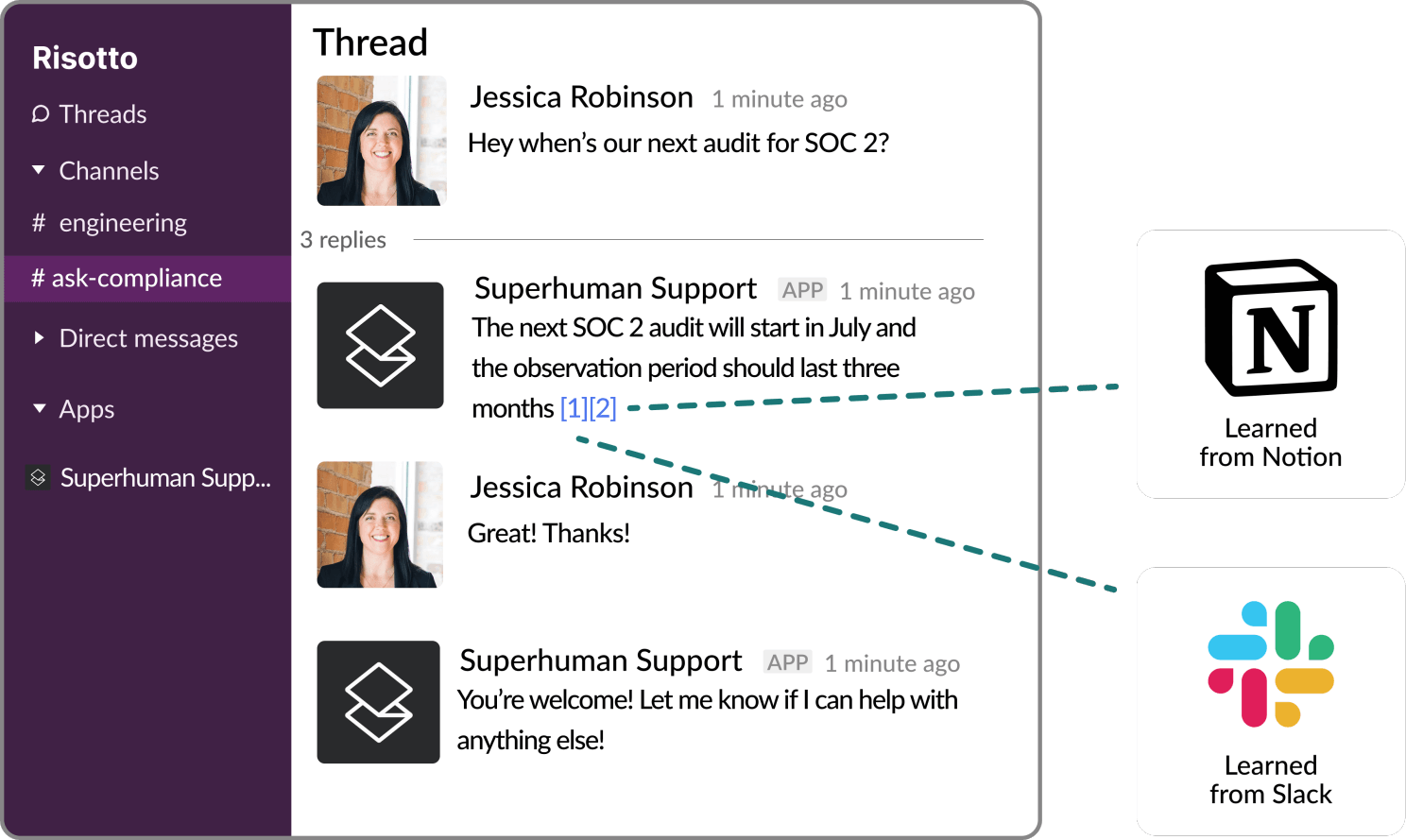
We spent 18 months training our algorithm to extract real knowledge from Slack conversations, and it was our hardest engineering challenge. Every Slack message goes through multiple quality checks before anything gets added to the knowledge base.
If the information is outdated or comes from an unreliable source, it gets filtered out. When it passes, that knowledge becomes available automatically.
“The killer feature for us was that it could effortlessly learn and capture knowledge that our team creates every day in Slack… with Risotto, instead of constantly writing new documentation, our team can simply answer questions, and Risotto learns as we go.”
– Phillip Rickett, VP of IT at Fundrise
“Risotto started answering complex product questions that even I didn’t know off the top of my head. It was pulling insights from our own past Slack conversations, surfacing knowledge that would have otherwise been buried.”
– Peter Hadjisavas, Head of IT at Hazel Health
“The more we use Risotto, the smarter it gets — that’s what makes it different from every other tool we’ve tried.”
– Peter Hadjisavas, Head of IT at Hazel Health
4. Access Automation Embedded Directly in the Help Desk

As we covered above, access requests typically make up 30–40% of IT ticket volume. Most teams end up managing access through a patchwork of tools and manual processes — and keeping that running smoothly as the org changes (new tools, updated policies, team restructures) is a constant lift.
Risotto takes a different approach: IGA automation is embedded directly in the help desk, so access management isn’t a separate system to maintain — it’s part of the same workflow employees already use to get IT help in Slack. When an employee asks for access to a tool, Risotto handles the full lifecycle:
- Collects business justification conversationally
- Routes approval to the right manager(s) based on the tool and the requester’s role
- Provisions and deprovisions automatically — including Just-In-Time (JIT) access that auto-revokes after a set period
Everything syncs to JSM in real time, and every step is documented for audit trails and compliance.
“We always wanted to require a reason for application access, but it was really difficult to integrate that into JSM. Risotto adds that functionality to JSM and so much more.”
– Tom Grinberg, IT Manager at Trust & Will
“When a team member asks, ‘How do I get access to Hightouch?’ they’re not looking for a link or a document; they need immediate, actionable assistance. Risotto intelligently understands the intent behind the request. It confirms existing permissions, coordinates necessary approvals proactively, and automatically provisions access upon approval.”
– Phillip Rickett, VP of IT at Fundrise
“The software access automations were a huge win for us. They were super easy to set up and we now have more than 30 applications with automated provisioning running 24/7.”
– Tom Grinberg, IT Manager at Trust & Will
“Automated software access saves us so much time. Within minutes people get the access they need with everything tracked, approved, and no additional overhead needed… For sensitive tools and resources Risotto’s automated time-based access has been a game-changer.”
– Collin Clifford, Legal & Compliance Manager at Superhuman
5. Beyond IT: Multi-Department Expansion
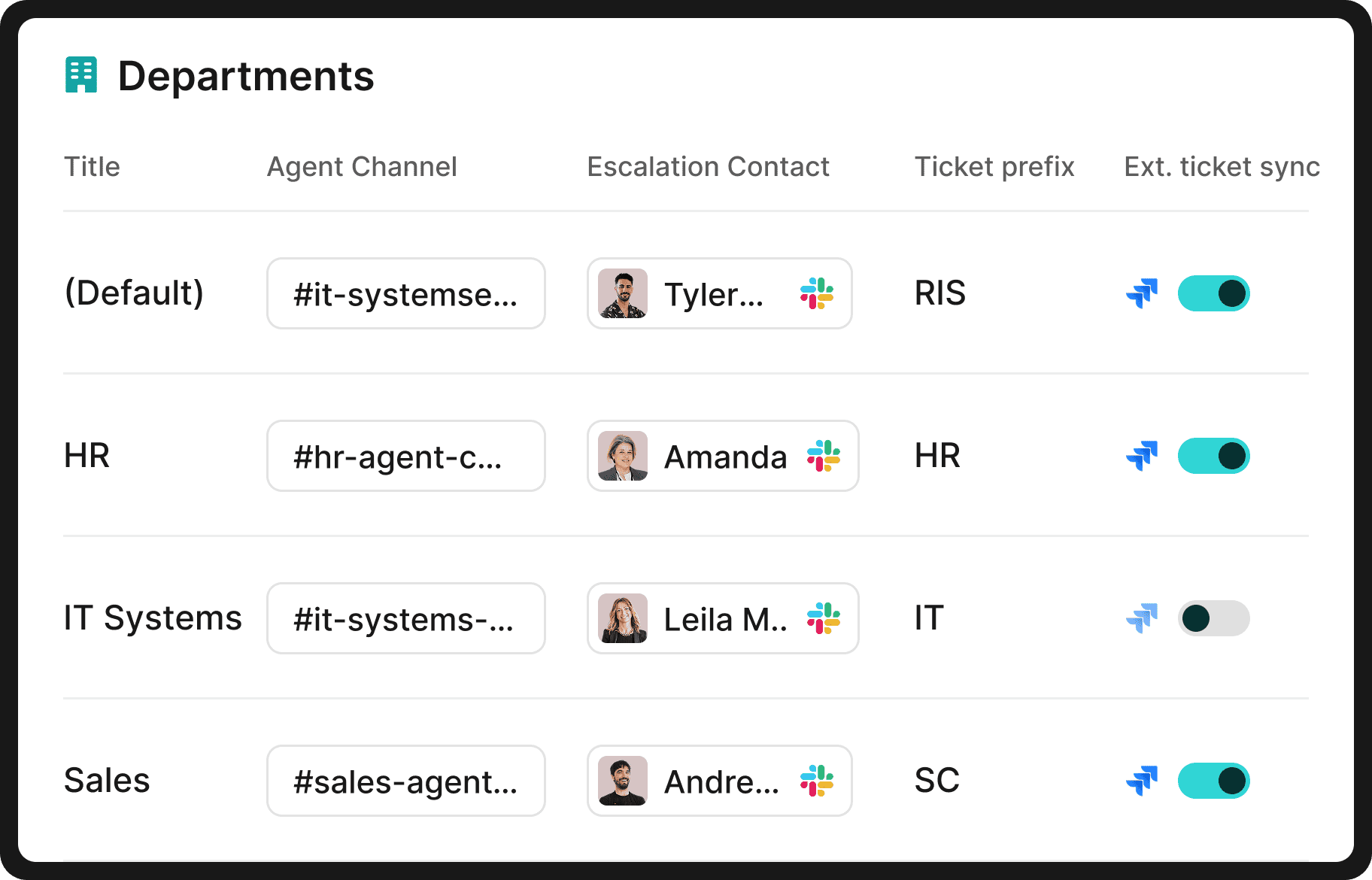
Once IT sees results with Risotto, other departments tend to follow. HR, Legal, Finance, Sales Ops, and others all deal with the same dynamic: repetitive questions that eat up time and could be automated.
But expanding the Virtual Service Agent to additional departments means building more intent flows and adding more configuration to maintain. For non-technical teams, that overhead often outweighs the benefit.
Risotto extends AI ticket resolution beyond IT to any department and it works out-of-the-box from day one:
- Each department can be set up in hours, and Risotto includes an optional lightweight built-in ticketing system that non-technical teams often prefer over JSM (though Risotto integrates with JSM just as well if a department wants to use it).
- Each team's data stays siloed — separate knowledge bases, permissions, escalation paths, and workflows so HR doesn't see IT tickets and vice versa.
- Ticket routing is automatic — requests get routed to the right team and person based on prior ticket history.
- Single license covers every department — no per-team pricing or add-on fees.
“The multi-department capabilities are awesome. Our engineering and RevOps teams now also want to use Risotto as they also get lots of the same questions over and over again.”
– Collin Clifford, Legal & Compliance Manager at Superhuman
“Once you add in HR, our combined automation rate is even higher at 50.2%.”
– Jason Huey, Senior IT Systems Administrator at ThoughtSpot
“Risotto started autosolving tickets immediately. Within the first few weeks, we saw departments that had never tracked ticket requests before — like our Cloud team — asking to get on the platform and streamline their support function.”
– Erik Van Dijk, Senior IT Manager at Jobber
Note: For more context on how Risotto augments Jira Service Management, see our articles on Atlassian Assist and Jira Conversational Ticketing.
Case Studies: Augmenting Jira Service Management with Risotto

Each of the companies below was using Jira Service Management and wanted to add AI ticket resolution without ripping out existing systems or spending months on configuration. They added Risotto on top — JSM stayed fully intact, and Risotto handled the AI resolution piece in Slack.
How Hazel Health Increased IT Automation by 4x after Replacing Jira Assist & Virtual Service Agent

- Before Risotto: Telehealth company supporting 5M+ students. IT team was running JSM + Jira Assist + Virtual Service Agent, with deflection rates stuck at 3–5% despite months of configuration
- Integrated with: Jira Service Management, Slack
- Results: Automation rates improved from 3–5% to over 20% (4x improvement). HIPAA compliant, 24/7 availability in Slack
As Peter Hadjisavas, Head of IT at Hazel Health, shared:
“We’ve completely replaced JIRA Assist with Risotto, it was a seamless transition. Ease of deployment was huge. We didn’t need a consultant or months of configuration. Risotto just worked.”
“The more we use Risotto, the smarter it gets — that’s what makes it different from every other tool we’ve tried.”
“Risotto is providing immediate answers 24/7, even when IT isn’t online. That’s a game changer.”
Note: For more details, read the full case study.
How Trust & Will Automated 35% of IT Tickets & Integrated With JSM & Slack

- Before Risotto: Over 50% of incoming tickets were access requests. JSM was in place as the ticketing system, but configuring meaningful access automation proved to be more overhead than it saved
- Integrated with: Jira Service Management, Slack
- Results: 35% of IT tickets automated, 30+ applications with automated provisioning running 24/7, compliance tracking built into every workflow
As Tom Grinberg, IT Manager at Trust & Will, shared on Risotto’s AI features:
“Risotto became the orchestration layer for Jira Service Management and gives us instant automation with AI. We always wanted to require a reason for application access, but it was really difficult to integrate that into JSM. Risotto adds that functionality to JSM and so much more.”
“The software access automations were a huge win for us. They were super easy to set up and we now have more than 30 applications with automated provisioning running 24/7.”
“Working with the Risotto team was awesome from day one. They all have IT backgrounds and really cared about making us successful.”
Note: For more details, read the full case study.
How ThoughtSpot Automated 48% of IT Tickets & Integrated with JSM, Slack, Okta, and Confluence
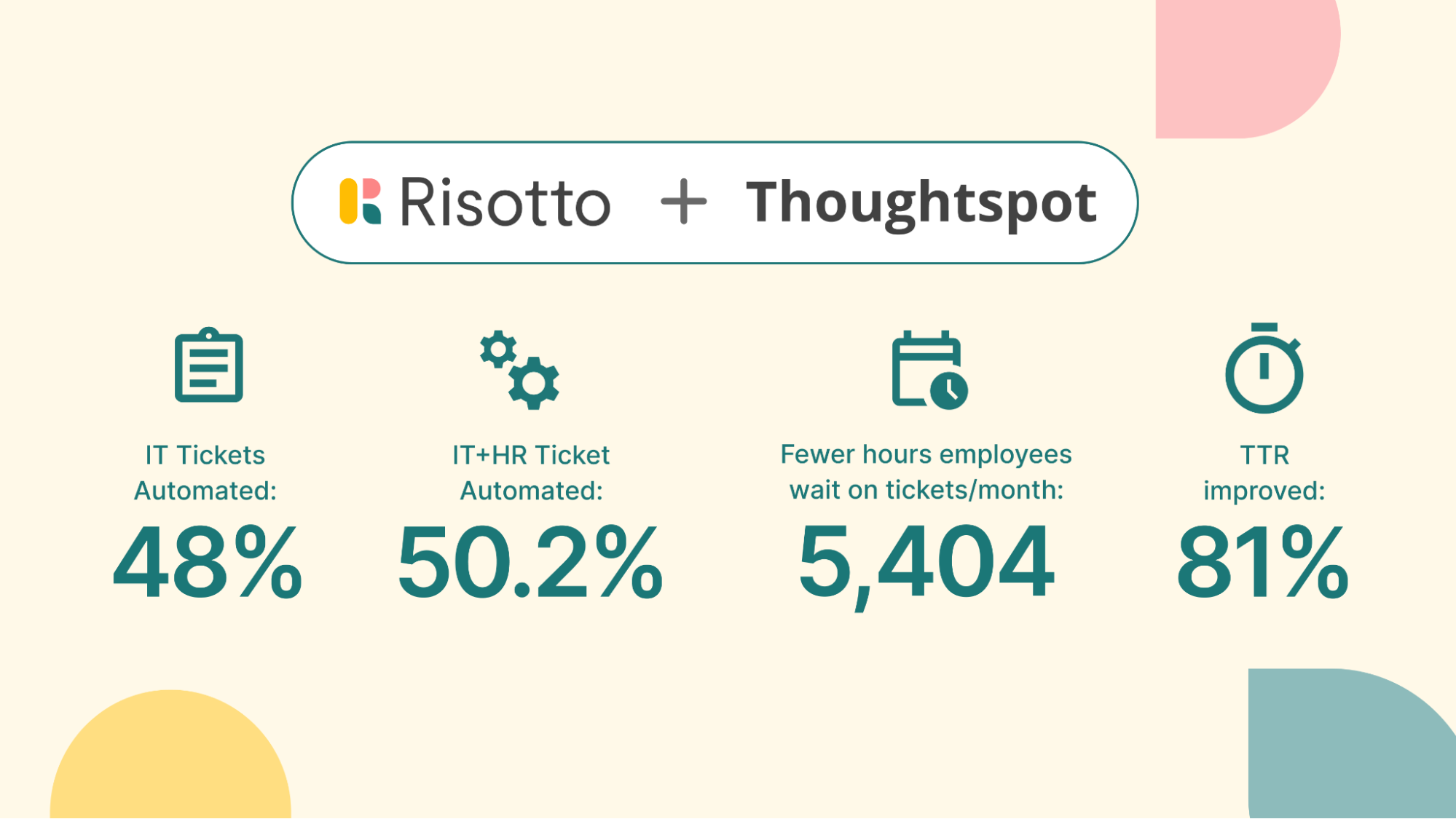
- Before Risotto: Lean IT team supporting 1,000+ employees with ~1,500 requests/month. Had evaluated several automation platforms, and each required too much configuration for the value delivered
- Integrated with: Jira Service Management, Slack, Okta, Confluence
- Results: 48% of IT tickets automated, resolution time dropped from 31 hours to 6.5 hours. After expanding to HR, combined automation rate hit 50.2%
As Jason Huey, Senior IT Systems Administrator at ThoughtSpot, shared on how Risotto helps optimize operations:
“Getting Risotto integrated with Jira, Slack, and Okta was so seamless and fast. Risotto is one of the easiest tools I’ve implemented. We were up and running in less than a week and already seeing our first autosolves.”
“The biggest gripe that our users had was that they would put in a ticket and it would just be lost into the ether for a couple days, and they would have to actually be the ones to bump it or get our attention on it.”
“Risotto takes away the telephone tag we had to play so now employees get what they need faster and more efficiently.”
Note: For more details, read the full case study.
How Gusto Automated 55% of IT Tickets & Integrated with JSM, Slack, Confluence & Okta

- Before Risotto: ~3,000 support requests/month across a growing enterprise. Existing chatbot lacked the integration depth and auto-learning capabilities they needed
- Integrated with: Jira Service Management, Slack, Confluence, Okta
- Results: 53% resolution rate on day one, 55% average, 114,000 hours of support wait time saved, 11 departments onboarded, 157 access rules, SOC 2 compliant
As Jose Izquierdo, Head of AI Operations at Gusto, shared:
“We came to Risotto hoping to hold the line — but the results blew away our expectations. We doubled our resolution rate on day one, and it hasn’t dropped since.”
“Employees can get help directly within Slack. They can kick off workflows for getting access to any internal tool, ask any HR-related question, or resolve questions about GitHub repository access — all without leaving Slack.”
Note: For more details, read the full case study.
How Jobber Automated 38% of IT Tickets & Integrated with JSM, Slack, AWS, Jamf, and Confluence

- Before Risotto: Five-person IT team, employees waiting 35 hours average for resolution. Had previously piloted another platform designed to streamline ticketing within Jira Service Management, but it wasn’t a fit.
- Integrated with: Jira Service Management, Slack, AWS, Jamf, Confluence.
- Results: 38% IT ticket automation, 41% Revenue Technology automation, AI TTR of 3 hours (down from 35), 2,747 hours saved, 30 apps and 12 departments integrated/
As Mike Smith, IT Operations Manager at Jobber, shared:
- “Risotto’s AI-powered support system had a massive impact straight out of the box and with very little setup. Employees now get fast, efficient answers with the same precision as one of our professionals.”
- “Risotto keeps a historical record of all the information an employee has provided, even links and screenshots… If someone on our team wants to take a look, they can reference Risotto and continue the conversation without asking for context all over again.”
Note: For more details, read the full case study.
Interested in Learning More About Risotto & Augmenting Jira Service Management?
If your team is using Jira Service Management and looking for higher auto-resolution rates than Virtual Service Agent can deliver, Risotto plugs directly into your existing JSM setup — no migration, no rip-and-replace. It resolves 20–60%+ of internal support tickets and improves key IT metrics like TTR and average first response time.
Because Risotto is purpose-built for IT ticket resolution with pre-built workflows for the highest-volume ticket categories, teams are typically up and running in hours, not weeks or months.
We invite you to:
Liked the article? Share on:
On this page
Try Risotto for free for 30 days. Commit only when you see the value.


See more recent articles



Want faster solutions and happier employees?
Access that's easy to ask for and impossible to get wrong.
Ensure Legal never answers another "do we need an NDA for this?"
Every policy question is stealing time from the work Finance was hired to do.
Turn Slack requests into action items instead of engineering interruptions.
The biggest deal risk might be an unanswered internal question.
Run a united support system that your employees can depend on.
Build the automations you’ve been planning on for months.
The bottleneck isn't your team. It's the groundwork before they can actually help.
Get support data that your team can talk to.
Jump on a call to understand:
Risotto handles repetitive support requests across tools and teams, so IT gets back to solving real problems, not rerunning the same ones.
.svg)
%20(1).webp)
See what makes the Iru integration a 10/10 for our clients.