%20(1).svg)


Docker Automates 68% of IT Tickets with Risotto
68%
175+
Every time Risotto releases new features, thereʼs always something in there that is valuable to us.

Challenge
Routine Support Pulled Senior Engineers Into the Queue
More than 20 million developers use Docker to build, share, and run applications. Behind that platform, Jeffrey Strauss, Director of IT and Workplace Operations, and Fiona McShane, Senior Automation Engineer, run point on the systems that keep Docker's distributed workforce secure and productive.
Docker's growth triggered a surge in support requests. The team was fielding nearly 600 requests monthly, rotating shifts to provide 24/5 first-line coverage. Hours of their day were lost to repetitive, routine requests instead of strategic, higher-impact work.
Outside that coverage window, requests escalated to a shared Slack channel. Password resets, app assignments, and Tier-1 troubleshooting pulled Fiona and her team into the queue. Even Jeffrey found himself answering Slack requests before 6 a.m. to support East Coast colleagues.
"We were balancing business-critical projects while keeping the lights on, making sure people weren't locked out of their systems or waiting days for help," shares Fiona. "All of that, plus routine support requests, was like 17 spinning plates."
Docker didn't want to take people out of support entirely. Jeffrey valued complex, higher-touch issues that build employee relationships and help the team learn. The team wanted employees to get fast, reliable answers, while keeping repeatable Tier-1 work from interrupting senior engineers.
Building a solution internally was possible, but Docker would still be responsible for model tuning, security, compliance, integrations, and after-hours maintenance. The team evaluated vendors, but a three-plus-month pilot repeatedly failed to use Notion data reliably, matched requests to the wrong services, and escalated too often.
Jeffrey knew they needed a platform built for IT, conversational by default, and capable of learning Docker's environment without a heavy lift from his team. That's when he found Risotto.
"We needed to handle a high volume of requests while remaining lean. I didn't want our senior engineers fixing someone's Wi-Fi when they could apply that time to more valuable, fulfilling work."
~Jeffrey Strauss
Solution
End-to-End Resolution Inside Docker's Existing Support Workflow
Fiona led Risotto's rollout, starting with Docker's IT and workplace operations team. Working in a sandbox, Risotto's team walked her through employee and agent views. Together, they connected core systems like Okta, pulled in Docker's support documentation, and built initial Runbooks for app assignment. By launch, Docker's IT team could build and refine workflows independently.
The impact showed up quickly. Unlike the prior pilot, Risotto matched requests to the right service. On the first day of production, the platform completed several app assignments automatically, resolving routine requests before they reached senior IT.
Today, Risotto handles most Tier-1 requests on the team's behalf, including app assignments, password resets, and knowledge questions. When employees message Risotto to join a Google Group, for example, they're added in seconds, replacing manual membership updates that used to land in the queue.
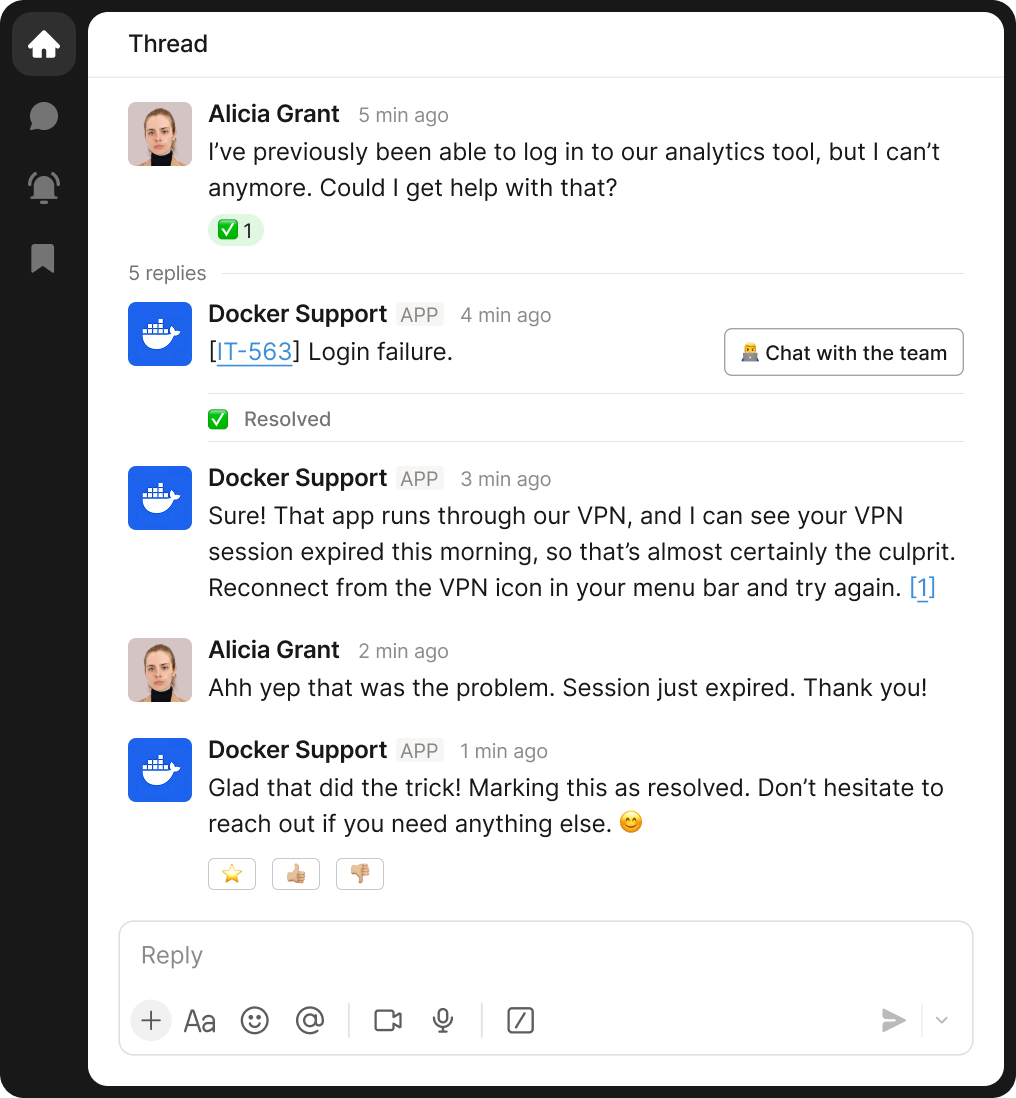
The success in IT quickly drew interest. Finance, Engineering, and other teams started asking when they could bring Risotto into their own channels. "It shows we made the right move," Jeffrey explains. "We have a lot of value we can provide to other teams, and Risotto enables that."
From there, Docker began using Risotto's API integrations to expand beyond IT intake. Risotto now processes access requests for tools outside Okta, extending automation beyond Docker's identity system. Employees send requests in Slack and receive assistance even when the IT team is offline, closing coverage gaps that once pulled senior team members into off-hours troubleshooting.
Finance was one of the first teams to follow IT's lead. The team began by connecting internal policy questions to Risotto, letting employees ask for help in Slack. Risotto reads approved policy docs and answers directly, giving employees faster responses and freeing Finance from repeat "What's our policy on..." tickets.
The platform has changed how Fiona reads the queue. Instead of scanning for tickets to pick up, she looks for the green indicators on completed requests.
From there, she moves to escalations, looking for the next knowledge source, integration, or Runbook to add. With Risotto's built-in automation tools, she's taken a new process from idea to a tested, live version in less than an hour. That change shows up in how she talks about her work. "My mind has shifted into looking for opportunity," Fiona explains.
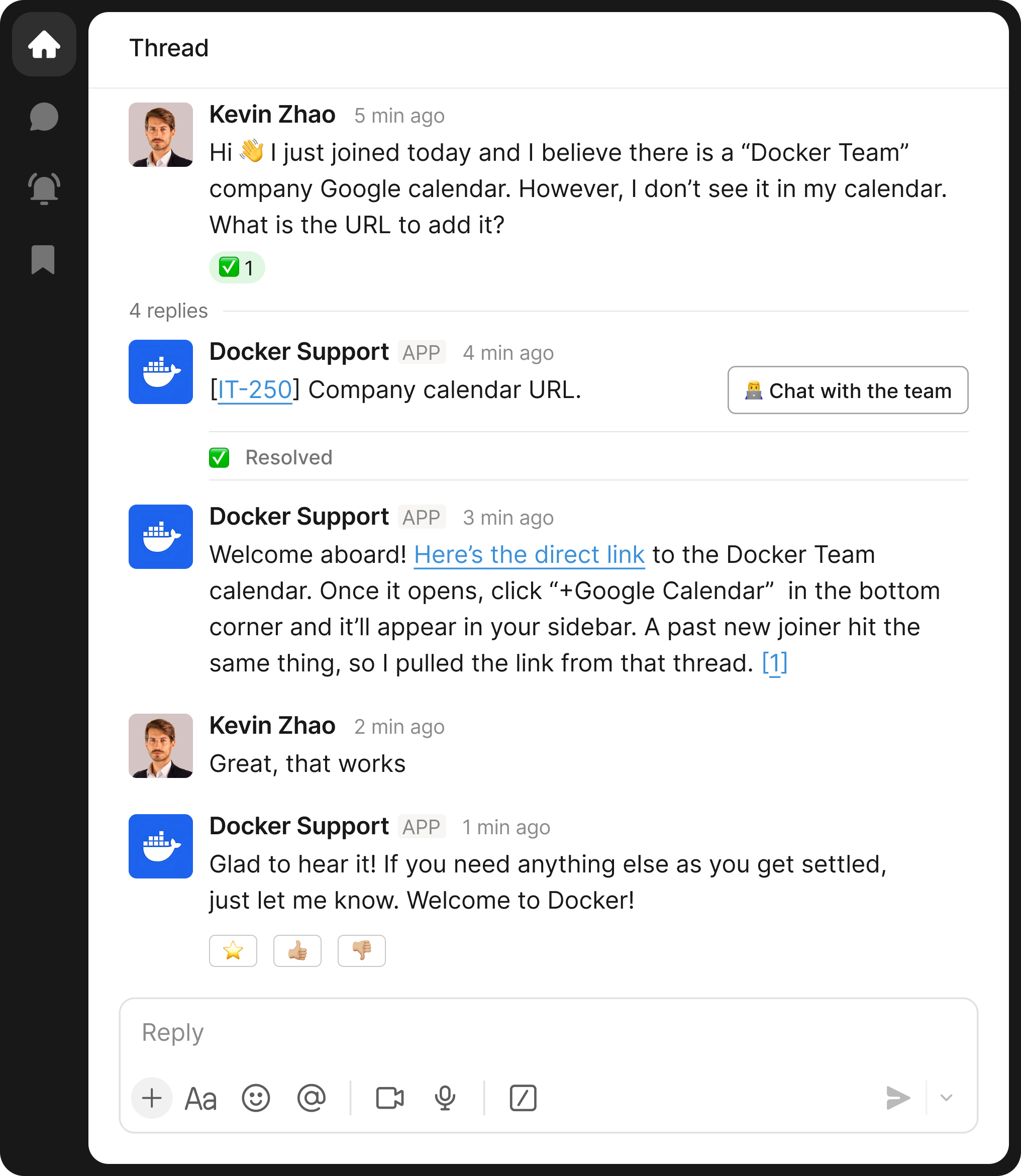
Jeffrey sees that same momentum in the partnership. "When we've submitted feature requests or surfaced an issue, those changes have often been built into the tool or resolved by our next sync," he says. "We're literally tuning Risotto in real time."
That responsiveness lets the team move faster and deliver more consistent help. For Docker, the queue is now a source of new opportunities, not just tickets to clear.
"The first real wow moment was when I watched a user go back and forth with Risotto on a Zoom issue and then solve it using only the knowledge we had uploaded. That was the moment I saw the platform's full conversational capabilities."
~Fiona McShane, Senior Automation Engineer at Docker
Results
New Support Processes Go From Idea to Live in Under an Hour
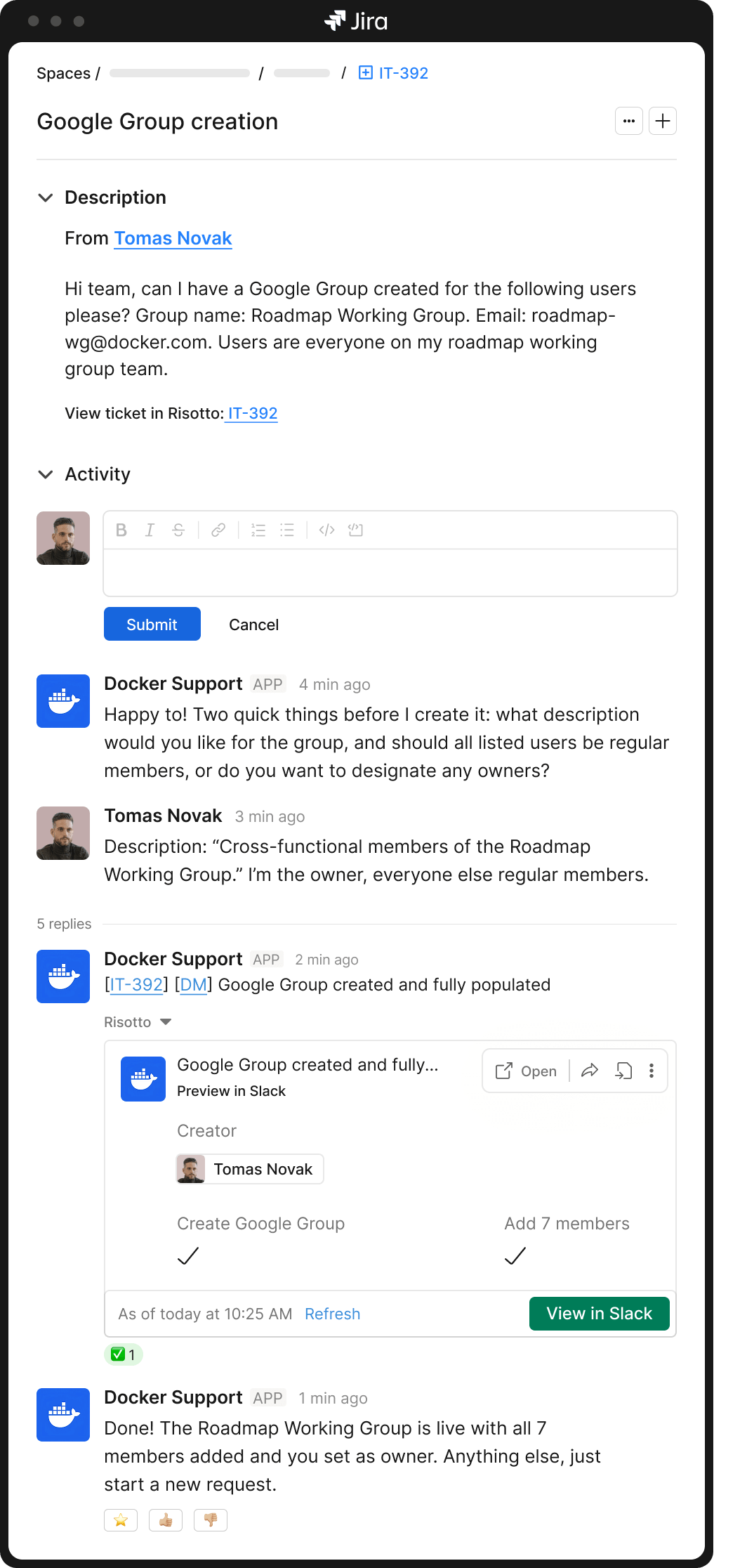
With Risotto in place, Docker turned a growing escalation queue into a single, automated support funnel for IT and Finance.
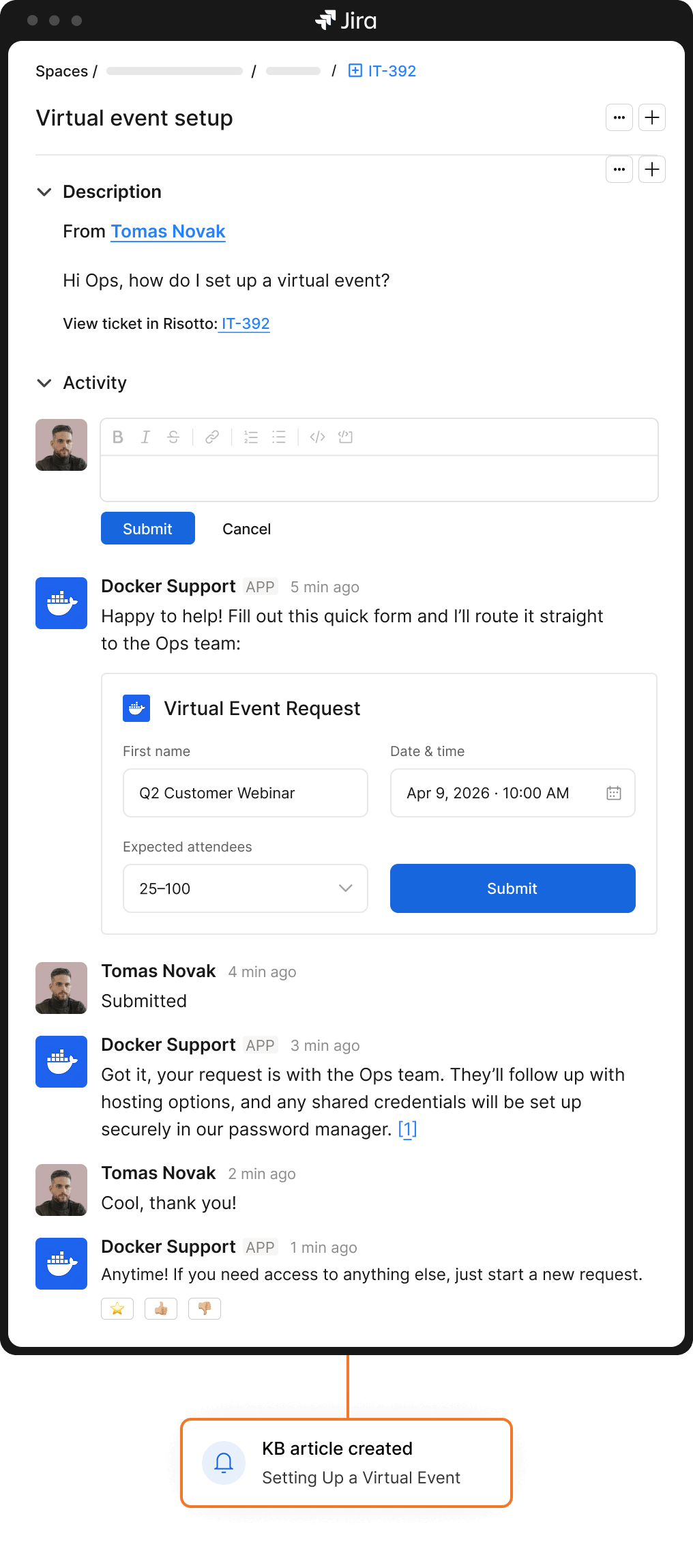
The results:
- 68% of IT tickets advanced or assisted by Risotto
- 27% of IT requests auto-resolved end-to-end each month
- 41% of Finance requests auto-resolved through approved policy documentation
- 1 hour from ideation to live support process
- 175+ weekly tickets handled across Docker teams
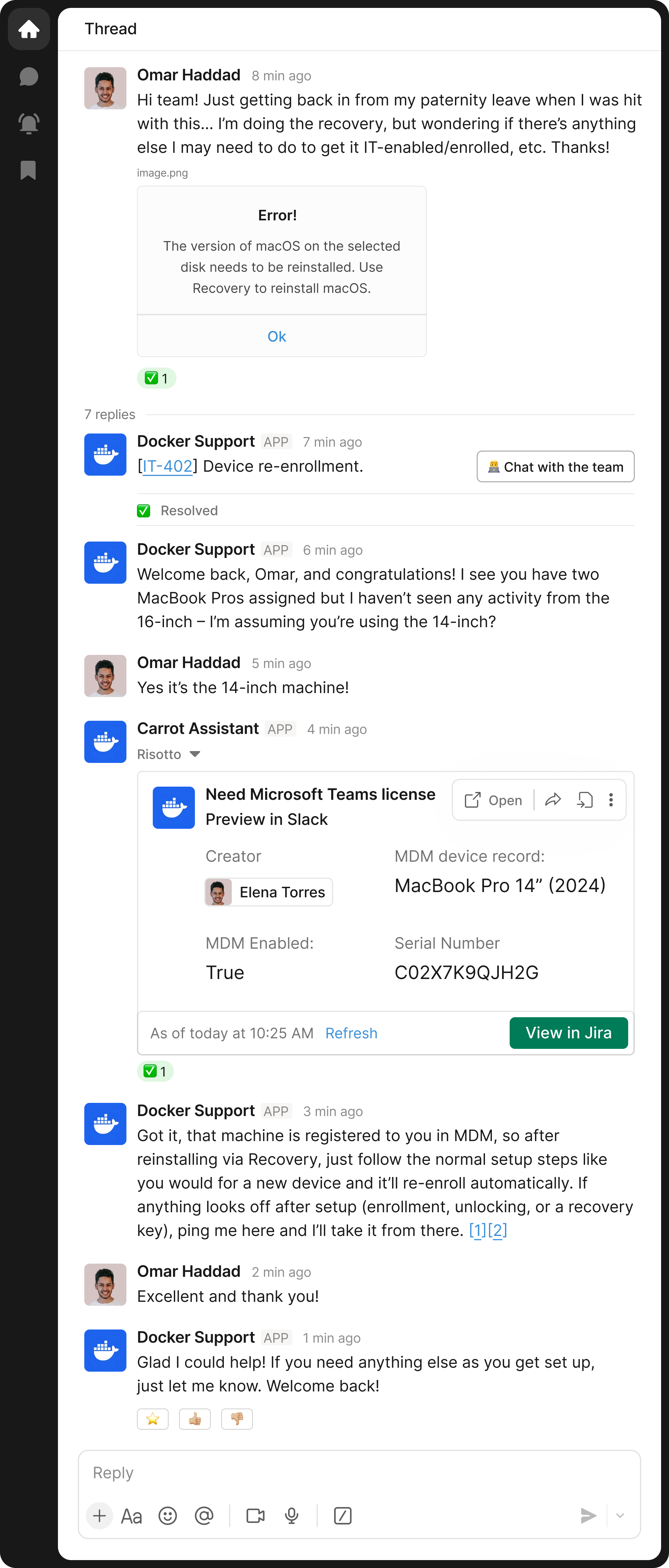
Looking ahead, Jeffrey and Fiona plan to automate more of Docker's device lifecycle, from provisioning to deprovisioning, through API integrations. As new features ship, the team looks for chances to plug them into existing workflows or roll them out to other teams across Docker

Share this article :
On this page
Try Risotto for free for 30 days. Commit only when you see the value.
See more recent stories


Gusto Auto-Resolves 55% of Tickets With Risotto


How Jobber Built Enterprise-Wide AI Support with Risotto
Want faster solutions and happier employees?
Access that's easy to ask for and impossible to get wrong.
Ensure Legal never answers another "do we need an NDA for this?"
Every policy question is stealing time from the work Finance was hired to do.
Turn Slack requests into action items instead of engineering interruptions.
The biggest deal risk might be an unanswered internal question.
Run a united support system that your employees can depend on.
Build the automations you’ve been planning on for months.
The bottleneck isn't your team. It's the groundwork before they can actually help.
Get support data that your team can talk to.
Jump on a call to understand:
Risotto handles repetitive support requests across tools and teams, so IT gets back to solving real problems, not rerunning the same ones.
.svg)
%20(1).webp)
See what makes the Iru integration a 10/10 for our clients.